The car rental market has become more fragmented in recent years. Alongside traditional rental desks at airports, travelers now use comparison platforms, local marketplaces, destination-specific brokers, and hybrid services that promise easier booking, lower prices, or more flexible conditions. The result is more choice, but also more uncertainty: the cheapest offer is not always the simplest, and the most recognizable brand is not always the best fit for a trip.
That is why the question of where it is better to rent a car is no longer about finding a single “best” company. It is about understanding which business model fits a specific route, country, budget, and tolerance for risk. In practice, the market is divided between global comparison platforms such as DiscoverCars and local-focused marketplaces such as Localrent.com, each with different strengths and trade-offs.
This review looks at how these platforms work, what they are good at, where they create friction, and which type of traveler may benefit from each model. The goal is not to rank one brand as universally superior, but to show how the structure of the rental market affects the experience.

How the car rental market changed
The biggest change is that car rental is now a multi-layered digital market rather than a simple transaction at a counter. A traveler can compare suppliers before arrival, prepay part of the booking online, filter by deposit size or mileage policy, and read review patterns that were once difficult to see. Platforms have made the market more transparent, but also more complex, because the final service is often delivered by a local supplier rather than the platform itself.
That distinction matters. A booking platform may have a polished interface, search tools, and clear pricing on the website, yet the actual handover, deposit handling, and vehicle condition depend on the rental partner. In car rental, the digital layer and the operational layer are not always the same company. This is one reason why two users can describe the same platform very differently.
What has also changed is the balance between global and local inventory. Large comparison platforms now aggregate offers across many countries and cities, while local marketplaces have become more visible in tourist destinations where regional operators can undercut global chains on price or offer more flexible terms. In other words, the market has split into breadth and depth: some services win by covering more countries, others by understanding one destination better than anyone else.
In practice, this means a platform can be excellent for one trip and only average for another. The best choice depends on whether the traveler values international coverage, local flexibility, standardized support, or the lowest headline price.
Why the question matters now
Choosing where to rent a car has become a financial and operational decision, not just a convenience decision. On a short leisure trip, a small difference in deposit policy or insurance terms can affect the entire experience. On a longer route, mileage limits, fuel policy, and pickup rules can materially change the final cost. The price shown at the search stage is only the beginning of the calculation.
That is especially true in destinations where local suppliers dominate. In such markets, a traveler may find a lower price through a local-focused marketplace, but the trade-off often involves less standardization and more attention required at pickup. By contrast, large global comparison platforms may offer stronger search tools and broader choice, but the underlying service quality still depends on the supplier selected within the platform.
For this reason, the real question is not “which service is best?” but “which service reduces the most risk for this particular trip?” That framing is more useful than chasing the cheapest listing. It also reflects how the market works today: the platform is only part of the product, and the supplier behind it is often the decisive factor.
What this means in practice is that a traveler renting in a major European capital, a Mediterranean island, or a smaller tourist destination may face very different market structures. A global aggregator can be ideal in one case and only a starting point in another.
What works now: the main rental models
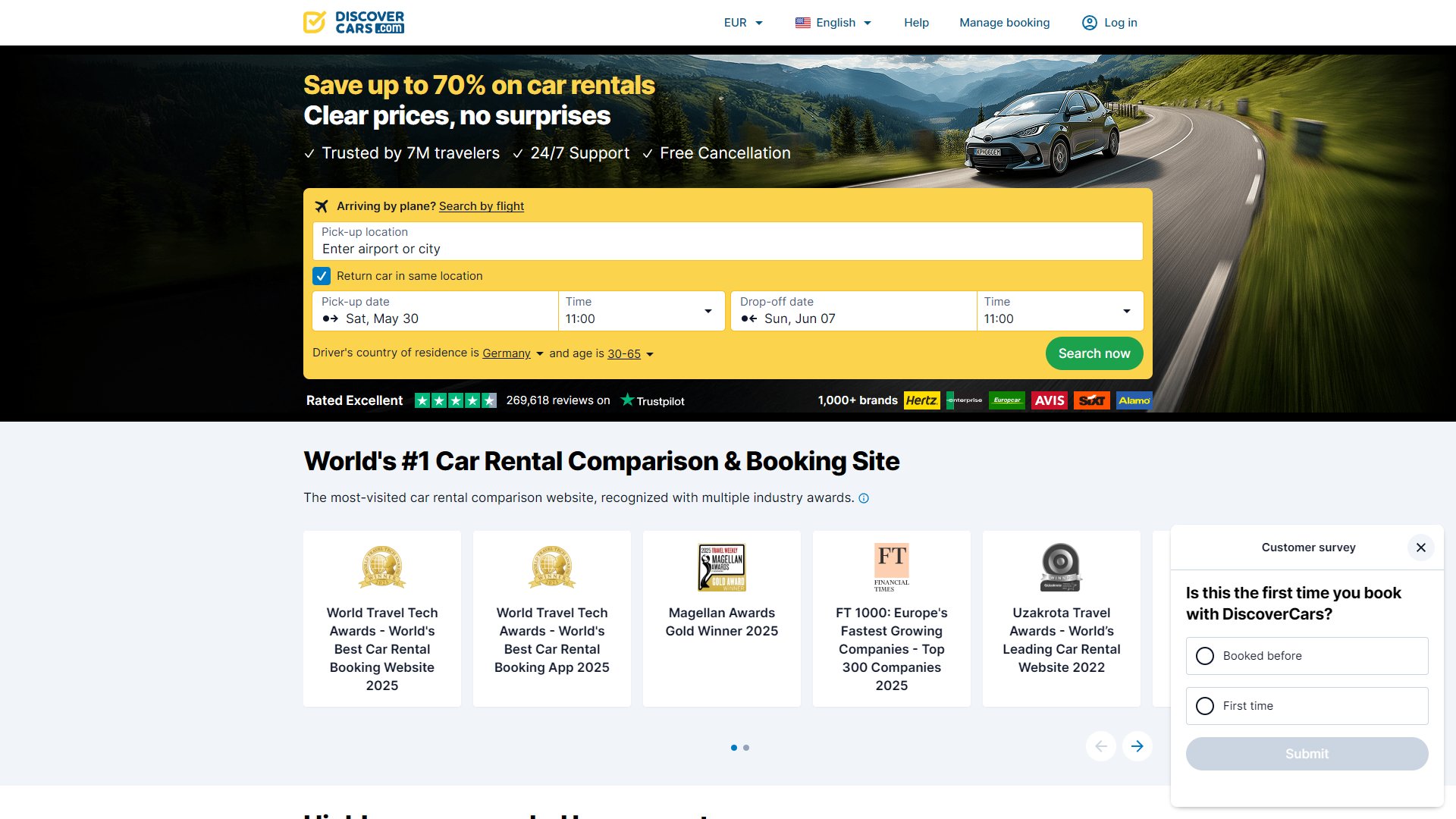
The current market is built around three broad models. The first is the global comparison platform. DiscoverCars is a strong example: it aggregates offers from many suppliers in multiple countries, emphasizes broad coverage, and gives users tools to compare price, fuel policy, transmission, mileage, deposit, and insurance conditions in one place. Its strength is scale and search efficiency.
The second model is the local-focused marketplace, where the platform works with regional suppliers in specific destinations. Localrent.com fits this category. It is especially relevant where local companies have strong inventory, competitive pricing, or delivery options that are more flexible than those of large chains. The advantage is local depth; the limitation is narrower geographic scope.
The third model is the hybrid or niche service, which usually combines digital booking with a more selective supplier network or a destination-specific commercial strategy. These services can be effective in certain markets, but they are generally more uneven in scale, brand visibility, and inventory breadth. They may be useful when a traveler wants a specific local setup, yet they are rarely the first choice for broad international comparison.
In practice, the “best” provider depends on the travel pattern. A traveler going to a major airport hub may benefit from a global aggregator. A traveler going to a resort region or island may get more value from a local platform. A traveler with strict requirements around insurance or pickup logistics may need to prioritize transparency over headline price.
What has become outdated
Several old assumptions no longer hold. The first is that the biggest rental brand automatically offers the safest experience. Large brands can be reliable, but they are not immune to local counter issues, additional charges, or rigid policies. Brand recognition helps, but it does not eliminate operational risk.
The second outdated idea is that the cheapest offer is the most economical. In car rental, the final bill is shaped by deposits, exclusions, fuel rules, cross-border restrictions, mileage caps, and the cost of optional insurance. A lower headline price can easily become a more expensive booking once the vehicle is picked up.
The third is that online booking has removed uncertainty. It has reduced some of it, but not all. The digital layer helps with comparison and planning, yet the handover remains a physical process governed by local rules, staff interpretation, and supplier-specific practices. That is why reading conditions is still essential even on the most modern platform.
In practice, the market rewards careful comparison rather than brand loyalty alone. The best results usually come from understanding the supplier model, not just the platform name.
Common mistakes travelers make
One of the most common mistakes is comparing only the base rate. A booking that looks cheap can become expensive if the deposit is high, the insurance is limited, or the mileage is restricted. Another frequent mistake is ignoring who actually supplies the car. A platform may look consistent, but the service quality can vary significantly from one local partner to another.
Another problem is booking without checking the pickup terms. Airport pickup, city-center pickup, hotel delivery, and meet-and-greet service are not interchangeable. Some suppliers charge extra for convenience, while others build those costs into the quoted price. A traveler who does not check these details may assume there is a hidden fee when the issue is actually a mismatch of expectations.
There is also a tendency to underestimate the importance of deposit and insurance structure. In many markets, the deposit is not a formality; it is a material part of the transaction. If the deposit is large, frozen for a long time, or tied to an unclear damage policy, the booking becomes riskier regardless of the price.
In practice, a good rental decision usually comes from reading the offer as a contract, not as an advertisement. The platform is only the front end; the terms are the real product.
How to choose: a practical framework
The most useful way to choose a rental service is to start with the trip structure. If the route spans multiple countries, airport hubs, or major cities, a global comparison platform is usually the most efficient starting point. If the trip is centered on one destination where local operators are known to be competitive, a local marketplace may produce better value.
Next, decide what matters more: price, simplicity, or control. Price-focused travelers often benefit from comparison platforms because they can see many offers at once. Travelers who want more localized offers and are comfortable reviewing conditions carefully may prefer destination-specific marketplaces. Those who value predictability may lean toward suppliers with stronger standardization, even if the headline price is higher.
Finally, evaluate the support model. A platform with strong digital tools is useful, but support quality matters when something goes wrong. The best service is not necessarily the one with the most vehicles; it is the one that resolves issues clearly when the car pickup does not match the booking page.
In practice, the right platform is the one that matches the trip’s complexity. Simpler trips can tolerate more variability. Complex trips need more structure and clearer terms.
Comparison of the main options by use case
To avoid misleading “best overall” labels, it is more accurate to compare services by use case and market model. Below is a practical overview based on scale, localization, and booking structure.
| Service | Market model | Best for | Strengths | Limitations |
|---|---|---|---|---|
| DiscoverCars | Global comparison and booking platform | Travelers who want broad coverage and easy price comparison | Large supplier network, wide destination coverage, strong filtering, recognizable international brand | Service quality depends on third-party suppliers; rental counter issues can still occur |
| Localrent.com | Local-supplier marketplace | Travelers in destinations where local operators are competitive | Destination depth, often strong local pricing, flexible local inventory | Narrower geographic scope, more variability between suppliers |
| Hybrid or niche platform | Selective booking service | Travelers with a specific destination or service preference | Can offer focused inventory or special conditions in selected markets | Usually less scale, weaker brand visibility, uneven coverage |
| Regional intermediary | Destination-specific marketplace | Short trips in concentrated tourist markets | Local knowledge, tailored offers, sometimes better delivery options | Limited standardization and narrower choice |
| Broker with selective inventory | Broker or marketplace | Users prioritizing specific terms over broad comparison | May provide niche conditions, local flexibility, or bundled offers | Harder to compare across destinations; service quality can be uneven |
In practice, DiscoverCars is usually the stronger option when the goal is broad comparison and international coverage, while Localrent.com becomes more attractive in destinations where local companies offer better value. The other services in this category are typically more situational: they can work well, but their usefulness depends heavily on geography and supplier quality.
Comparison of DiscoverCars and Localrent.com
These two platforms illustrate the main divide in the market. DiscoverCars is built for breadth. It operates as a large-scale comparison and booking platform with global reach, broad assortment, and a strong digital search experience. Its value lies in aggregation: the user can compare multiple suppliers across many destinations and make a booking through one interface.
Localrent.com is built for local depth. It focuses on local rental companies in travel destinations and often surfaces inventory that may be more competitive in specific markets. Its value lies in local relevance: it can be especially useful where regional suppliers are stronger than global chains or where the traveler wants more destination-specific options.
The trade-off is clear. DiscoverCars is usually better when the traveler wants scale, visibility, and a wide choice of suppliers. Localrent.com can be better when the destination itself favors local operators and the user is comfortable reviewing terms carefully. Neither model is inherently superior; they solve different problems.
In practice, the better choice depends on the destination structure. A city with dense airport competition and many suppliers often favors a large aggregator. A holiday destination with a strong local rental ecosystem may favor a local marketplace.

Price, conditions, and the real cost of renting
Car rental pricing is rarely just about the daily rate. The real cost includes the deposit, the insurance structure, the fuel policy, the mileage policy, and any charges related to delivery, extra drivers, or border crossing. Two offers with the same headline price can differ significantly in total cost and risk.
DiscoverCars tends to be strong at exposing those differences because its comparison model makes it easier to see multiple suppliers side by side. Localrent.com can also be transparent, but the user must pay close attention to the specifics of each local supplier. In both cases, the final price should be treated as a package, not as a number.
In markets where local suppliers are price-competitive, a local marketplace can produce better value than a global brand. But lower cost should be weighed against predictability. A slightly more expensive booking can be the better deal if it reduces friction at pickup or limits the amount of money tied up in deposits.
In practice, price comparison only works when the entire rental structure is compared. A traveler who ignores insurance or deposit terms is not comparing offers; they are comparing advertisements.
Case patterns from the market
One common pattern is the airport trip in a major European destination. In that case, a global platform often makes sense because there are many suppliers, a wide spread of prices, and enough competition to justify comparison. The traveler benefits from breadth, and the platform’s filtering tools become genuinely useful.
Another pattern is the island or resort destination, where local operators may dominate the supply side. In those markets, Localrent.com and similar services can be strong because they surface vehicles that may not appear prominently on global platforms. The traveler may find better delivery options, more flexible pickup arrangements, or more competitive local pricing.
A third pattern is the short-term, low-friction rental for a city break. Here, simplicity matters more than the absolute lowest price. A platform with clear conditions, responsive support, and a straightforward booking flow may be worth more than a slightly cheaper but more opaque listing.
In practice, the best platform depends on the route type. The market does not reward one-size-fits-all thinking.
Risks and limitations
The main risk in platform-based car rental is the gap between booking expectations and counter reality. This can involve deposits, insurance exclusions, vehicle class substitutions, or local rules that were not fully understood during booking. The more the traveler relies on the website summary alone, the larger the risk.
Another limitation is that platforms do not own the fleet in most cases. That means service quality is partially outsourced. Even a well-designed marketplace cannot fully control the behavior of every local supplier in every destination. This is why review quality and supplier reputation matter so much.
There is also the issue of dispute handling. When a problem arises, the traveler may need to deal with the platform, the supplier, and sometimes the insurance provider. The process can be manageable, but it is rarely as simple as a direct rental from a single highly standardized operator.
In practice, the safest booking is not necessarily the cheapest one. It is the one with the clearest rules and the least room for interpretation at pickup.
FAQ
Is a global comparison platform always better?
No. A global platform is better when the traveler needs broad coverage and wants to compare many suppliers quickly. It is less useful when the destination is dominated by local operators with better local pricing or more flexible terms.
Is Localrent.com better for local destinations?
Often yes, especially when the destination has a strong local rental ecosystem. The platform’s strength is its local supplier orientation, but the user still needs to review each offer carefully.
Should price be the main selection criterion?
Not by itself. Price matters, but deposit size, insurance coverage, mileage limits, and pickup conditions can change the actual value of the booking.
What is the biggest mistake travelers make?
Comparing only the headline rate and ignoring the rental conditions behind it. In car rental, the contract details are often more important than the marketing price.
Which service is safest?
No platform removes risk completely. The safer choice is the one that offers the clearest terms, the most suitable supplier model, and the best fit for the destination.
Conclusion
If the question is where it is better to rent a car, the most honest answer is that it depends on the structure of the trip. For broad international comparison, DiscoverCars is one of the stronger options because of its scale, coverage, and filtering tools. For destination-specific local inventory, Localrent.com can be a more effective choice because it is built around local suppliers and regional market conditions.
The broader lesson is that the car rental market is no longer a simple choice between one company and another. It is a decision about market model, supplier quality, and risk tolerance. Travelers who understand that difference are more likely to get a booking that works well in real life, not just on the search results page.
In the current market, the best rental decision is rarely the most visible one. It is the one that fits the destination, the route, and the level of certainty the traveler needs.