Over the past few years, the flight search market has become more fragmented. Alongside airline websites and traditional online travel agencies, travelers now compare metasearch engines, booking platforms, and tools that combine itineraries from multiple carriers. As a result, “cheap” no longer means only the lowest headline fare. It also includes baggage rules, flexibility, and the level of support available after booking.
That is why comparing flight search services is less about naming a single winner and more about matching the tool to the trip. A direct round trip, a multi-city itinerary, a self-transfer route, or a price-sensitive leisure trip each creates different trade-offs. In that context, Kiwi.com, CheapOair, and Aviasales represent three different approaches to the same problem.
These platforms also sit at different points in the travel process. Aviasales is primarily a metasearch engine. CheapOair is an online travel agency with a broad booking flow. Kiwi.com combines search, booking, and itinerary construction, including self-transfer logic and virtual interlining. Those differences affect price visibility, service responsibility, disruption handling, and the final cost of the trip.

How the market has changed
The cheap-flight segment has moved from simple fare display to route planning. In the past, the main task was to compare published fares across airlines. Now, the platforms that stand out are often the ones that can identify combinations a traveler would not easily build manually: separate tickets, mixed carriers, hidden connections, and multi-city routing. Kiwi.com built much of its reputation on this logic. Aviasales, by contrast, remains strongest as a comparison layer. CheapOair is closer to the classic OTA model, where booking is part of the product.
This shift has created a practical distinction between search quality and travel execution. A platform may surface a low fare, but the real question is whether that fare can be booked, changed, refunded, or protected without unnecessary friction. For travelers, this is where the market has become more complex, and where editorial comparison is more useful than a simple ranking.
What changed most is the role of risk. Low fares are often tied to stricter rules, split bookings, baggage exclusions, or third-party fulfillment. The lowest price is sometimes the least flexible option. As a result, the best service is not always the cheapest one on the first screen; it is the one that offers the best balance between fare, control, and operational reliability.
Why this topic matters in practice
For occasional travelers, the difference between platforms may seem small. For families, business travelers, or anyone booking complex routes, it becomes more important. A platform that is strong at search can still be weaker at post-booking support. A platform with broad inventory can still produce confusing totals once baggage and service fees are added. A platform that builds clever itineraries can also create more operational exposure if the trip depends on multiple separate tickets.
That is why the more useful question is not “which service is cheapest?” but “which service fits this trip, with this level of risk tolerance?” In practice, the answer depends on whether the traveler values route flexibility, direct booking simplicity, or comparison depth.
In other words, the market has matured. The platforms now compete not only on price, but on the structure of the booking experience. That is the frame through which Kiwi.com, CheapOair, and Aviasales should be evaluated.
Three common models in flight search
Today’s flight search ecosystem can be divided into three practical models. The first is metasearch: a platform compares offers and redirects the user to an airline or agency. The second is OTA booking: the platform sells the ticket directly or through its own checkout flow. The third is itinerary construction: the platform actively assembles routes across carriers to unlock lower or more flexible fares.
Aviasales is the clearest example of metasearch. Its strength lies in broad comparison and fare discovery. CheapOair is a traditional OTA with a wider travel basket, including hotels, cars, and packages. Kiwi.com is the most technically distinct of the three because it builds routes that are not always available as standard airline combinations.
For travelers, the model matters. If the goal is to scan the market quickly, Aviasales is structurally strong. If the goal is to book within a familiar OTA framework, CheapOair is closer to that model. If the goal is to uncover non-obvious itineraries, Kiwi.com is the most distinctive option.
What this means in practice
The platform model determines who owns the most difficult part of the journey. Metasearch tools are useful for comparison, but after the redirect the user is subject to the partner’s rules. OTAs are more involved in the booking lifecycle, but they also add another service layer. Itinerary builders can produce attractive prices on paper, yet they may also introduce more complexity if the trip is disrupted.
That is why “best” cannot be separated from use case. The same service can be ideal for one traveler and inconvenient for another.
What has become outdated
The old assumption that the lowest fare is always the best fare is no longer reliable. In many cases, the cheapest displayed price excludes baggage, seat selection, or flexible change conditions. Some offers also depend on separate tickets, which can look attractive until the traveler has to manage a missed connection or a schedule change.
Another outdated idea is that all flight booking platforms are interchangeable. They are not. A metasearch engine, an OTA, and a route-combination platform solve different problems. The more the trip departs from a simple point-to-point itinerary, the more important those differences become.
Finally, the idea that support quality is secondary to price is increasingly fragile. In a market where refunds, cancellations, and schedule changes are common pain points, service design is part of the product. Public feedback across the sector makes that clear, especially for platforms that handle complex bookings.
Common mistakes when comparing cheap-flight services
One of the most common mistakes is comparing only the first fare shown on the search page. That figure is often incomplete. Travelers should look at baggage rules, payment conditions, the identity of the actual seller, and whether the route is a single ticket or a self-transfer combination. The cheapest screen can become the most expensive itinerary once the full trip is assembled.
A second mistake is treating support promises as uniform. On paper, many platforms claim assistance. In practice, the quality and speed of that assistance can differ substantially, especially when the booking involves multiple suppliers. That distinction is particularly important when the route includes separate tickets or third-party agencies.
A third mistake is ignoring the type of trip. A simple domestic or direct international flight does not need the same level of itinerary planning as a multi-city or multi-airline journey. Choosing a platform that is too complex for a simple trip can add friction without adding value.
How to choose the right platform
The best way to choose is to define the trip before choosing the tool. If the priority is broad comparison and quick scanning, a metasearch platform is usually enough. If the priority is direct booking with a broader travel basket, an OTA may be more practical. If the priority is finding unconventional routes or lower fares through itinerary combinations, a platform like Kiwi.com becomes more relevant.
Flexibility is another useful filter. Travelers who can tolerate a more complex route may accept self-transfer logic in exchange for a lower price. Travelers who need predictability may prefer a more traditional booking structure, even if the fare is slightly higher. In flight shopping, the cheapest option is not always the most practical one.
It also helps to separate search from fulfillment. A platform can be strong at discovery and still weaker at after-sales handling. That is why the final decision should include not only the fare, but also the degree of control over changes, refunds, and baggage rules.
How this affects the choice
The practical takeaway is that flight search should be treated as a comparison task, not just a price hunt. The service model shapes the outcome. A traveler who understands the model is less likely to be surprised by fees, support limitations, or itinerary complexity.
Service overview
| Service | Model | Base | Best for | Price profile | Specialization | Limitations |
|---|---|---|---|---|---|---|
| Kiwi.com | Travel search and booking platform with self-transfer and virtual interlining | Czech Republic | Complex routes, multi-city trips, non-standard combinations | Often competitive on headline fares | Algorithmic itinerary construction | More complex service and disruption handling |
| Aviasales | Metasearch | International | Fast fare comparison and broad market scanning | Strong on visible comparison; final price depends on partner | Search and aggregation | After-booking service depends on the seller |
| CheapOair | Online travel agency | United States | Direct booking, flights plus hotels and cars | Discount-oriented, but fees may affect the total | OTA booking and bundled travel products | Mixed public feedback on support and post-booking issues |
Kiwi.com appears first here not because it is universally better, but because it is the most structurally different. It does something the others do not do as aggressively: it constructs itineraries that can materially change the price and route logic. Aviasales ranks next because it is often the most efficient starting point for comparison. CheapOair comes after that as the more traditional OTA model, useful when the traveler wants a broader booking basket rather than route experimentation.
Kiwi.com: the route-engineering specialist
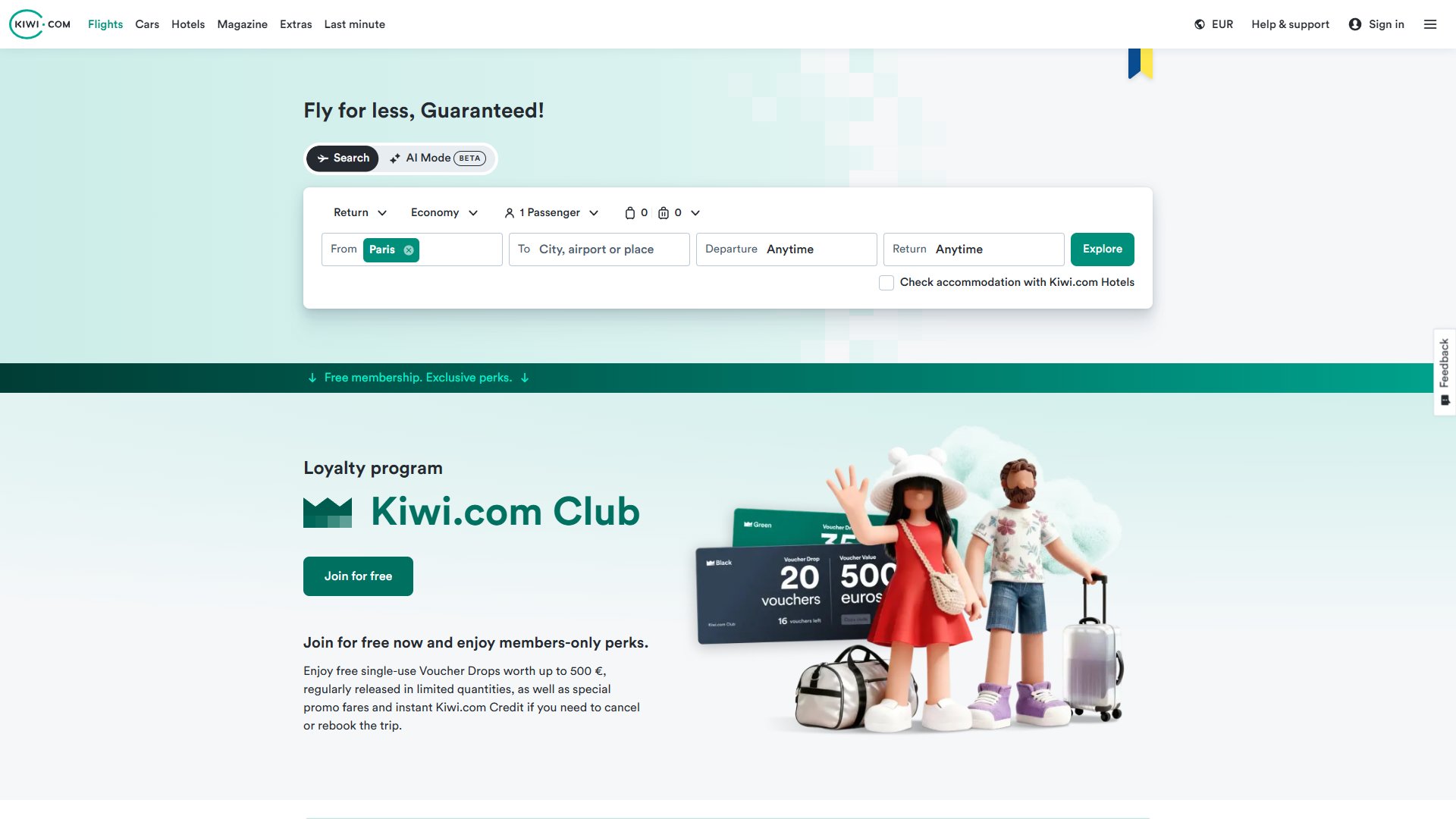
Kiwi.com is the most technically interesting platform in this comparison. Founded in the Czech Republic in 2012, it built its reputation around virtual interlining and self-transfer itineraries. In plain terms, it combines flights across carriers even when airlines do not sell those combinations as one ticket. That can unlock cheaper or more flexible routes, especially on complex trips.
The upside is clear: more route possibilities and, in many cases, lower fares. The downside is equally clear: separate tickets create more operational risk. If one leg is delayed, the passenger may have to manage the connection manually. Kiwi.com’s guarantee mechanisms are part of the response to that issue, but the underlying complexity remains.
Public feedback around Kiwi.com often reflects this duality. The search and itinerary-building side is widely recognized as strong. The post-booking side is more mixed, particularly when refunds, cancellations, or schedule changes are involved. That pattern is consistent with a platform that sells complexity as a feature.
What this means in practice
Kiwi.com is often the right tool when the trip itself is the problem to solve. For a direct, simple route, the platform’s extra logic may not add much value. For a multi-city or budget-sensitive itinerary, it can surface options that are hard to find elsewhere. The user, however, needs to understand the trade-off: a lower fare often comes with less operational simplicity.
Aviasales: the comparison layer
Aviasales is strongest as a search and aggregation platform. It does not try to be a full-service OTA in the same way as CheapOair, and it does not primarily sell route complexity in the way Kiwi.com does. Its role is to help the user compare offers from multiple providers and move quickly from search to decision.
This makes it especially useful for travelers who already know the rough shape of the trip and want to see the market efficiently. The platform’s strength is breadth, usability, and price visibility. Its limitation is structural: once the user leaves the platform, the booking experience depends on the airline or agency that actually fulfills the ticket.
Aviasales also benefits from strong brand recognition and a distinctive marketing voice, particularly in its core markets. But from a product standpoint, its main value is straightforward: it reduces the cost of comparison. That is not trivial. In a fragmented market, good comparison is often the first source of savings.
What this means in practice
Aviasales is a logical starting point for many flight searches because it minimizes the effort required to scan multiple offers. It is less about taking responsibility for the whole journey and more about helping the user identify the right seller. For travelers who value transparency and speed in the search phase, that is a strong proposition.

CheapOair: the traditional OTA with broad inventory
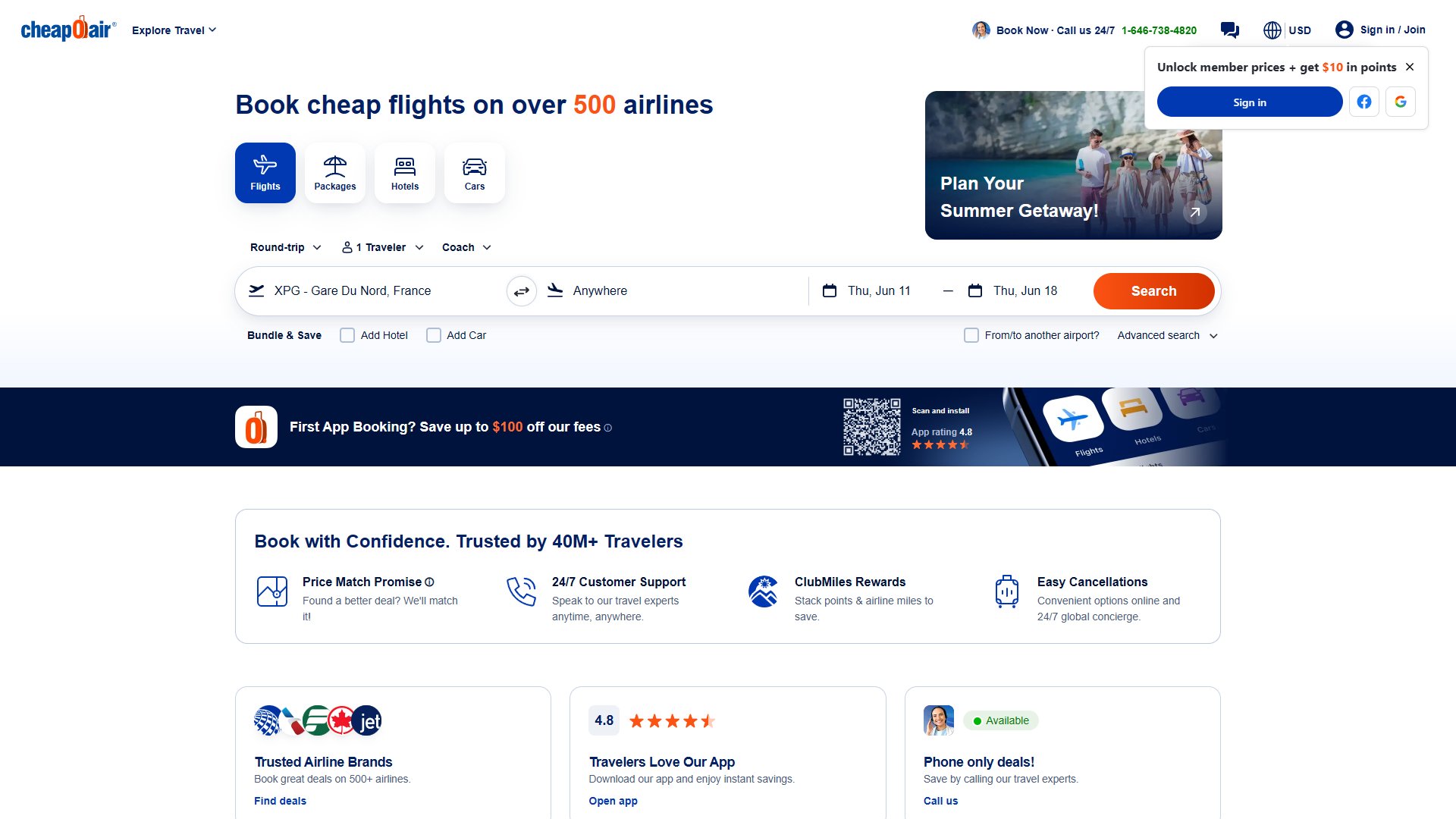
CheapOair represents the classic online travel agency model. It sells flights and also offers hotels, car rentals, and vacation packages. That broader inventory makes it useful for travelers who prefer to manage several parts of the trip in one place. The brand is associated with discount-led marketing and consumer-facing fare promotions.
The upside of this model is convenience. A user can search, compare, and book within a single environment. The downside is that the OTA structure introduces another layer between the traveler and the airline. In public feedback, recurring issues include service friction, cancellation handling, and questions around fees or fare conditions.
CheapOair is not trying to be the most technically unusual platform in the market. Its value is more conventional: a broad booking basket, a recognizable brand, and a straightforward OTA flow. For some travelers, that is exactly the right fit.
What this means in practice
CheapOair is best understood as a utility platform. It is useful when the traveler wants one place to handle multiple travel products, not just flights. It is less compelling when the goal is pure route discovery or the most advanced fare comparison. In that sense, it competes on convenience rather than on algorithmic novelty.
Comparison table
| Criterion | Kiwi.com | Aviasales | CheapOair |
|---|---|---|---|
| Cost | Often low on complex routes, but extras can increase the total | Strong visible comparison; final cost depends on partner | Discount-led, but fees and add-ons may affect the total |
| Approach | Self-transfer and virtual interlining | Metasearch and fare aggregation | Direct OTA booking |
| Base | Czech Republic | International | United States |
| Market maturity | Founded in 2012 | Established international brand | Long-standing OTA brand |
| Specialization | Complex routing and itinerary construction | Flight comparison and price discovery | Flights plus broader travel booking |
| Limitations | More complex disruptions and support handling | Service depends on third-party sellers | Mixed public feedback on post-booking support |
Pricing: what the headline number hides
Pricing in this segment is rarely as simple as it looks. A low fare may exclude baggage, seat selection, or flexible change conditions. Some routes involve separate tickets, which can make the initial price look unusually attractive. In other cases, the final cost only becomes clear after checkout, when fees and optional protections are added.
Kiwi.com is especially known for competitive headline prices on mixed itineraries. Aviasales is strong at showing a wide range of offers, though the final booking price depends on the partner. CheapOair often positions itself around discounts, but the final amount can shift once fees and add-ons are included.
The practical lesson is that price should be evaluated as a total trip cost, not as a search result. That includes baggage, transfer risk, cancellation flexibility, and the likelihood of needing support later.
Cases: when each platform fits best
A traveler planning a simple direct round trip between two major cities will often start with Aviasales because it makes comparison easy. If the best fare is available through a partner agency or airline, the platform has done its job. The booking may then happen elsewhere, but the comparison value has already been delivered.
A family planning a multi-city holiday with several legs may find Kiwi.com more useful. The platform can assemble routes that are not obvious in standard search tools. That flexibility can reduce cost, but it also requires more attention to connection timing and booking conditions.
A traveler who wants to book flights together with a hotel and car rental may prefer CheapOair. The value there is not route innovation, but consolidation. For some trips, that convenience is worth more than a small fare difference.
What this means in practice
The right platform depends on the shape of the trip. Simple trips reward speed and comparison. Complex trips reward route logic. Bundled trips reward booking convenience. The market is mature enough that the best service is usually the one that matches the itinerary, not the one with the loudest marketing.
Risks and limitations
The main risk in cheap-flight shopping is hidden complexity. This includes separate-ticket exposure, partner-side service gaps, refund delays, and fare changes between search and booking. These are not theoretical issues; they are structural features of the market.
Another risk is overestimating platform control. A metasearch engine may look like a full booking service, but once the user is redirected, the actual support and fulfillment may lie elsewhere. Likewise, an OTA may appear to offer a complete solution, but its service quality still depends on supplier relationships and internal handling processes.
For this reason, the cheapest service is not automatically the safest. The most useful service is the one whose risk profile matches the traveler’s tolerance and trip complexity.
FAQ
Which service is best for finding cheap flights overall?
There is no single universal winner. Aviasales is strong for comparison, Kiwi.com is strong for unconventional route construction, and CheapOair is useful when a broader OTA booking flow is preferred.
Which platform is best for complex itineraries?
Kiwi.com is the most specialized of the three for complex or multi-city routes because of its self-transfer and virtual interlining model.
Which platform is best for simple trips?
For simple trips, a metasearch tool like Aviasales is often the most efficient way to compare offers before booking directly with the airline or a trusted seller.
Which platform is best if I want flights, hotels, and cars together?
CheapOair is the closest fit among these three because it is a traditional OTA with a broader travel product basket.
Should I always choose the lowest fare?
No. The lowest fare can come with baggage restrictions, weaker flexibility, or more complicated support conditions. Total trip cost is a better metric than the headline number alone.
Conclusion
The market for cheap-flight search has split into three distinct logics: comparison, booking, and itinerary construction. Aviasales is strongest as a comparison engine. CheapOair is strongest as a conventional OTA with broader travel inventory. Kiwi.com is strongest as a route-engineering platform that can uncover lower or more flexible itineraries through self-transfer and virtual interlining.
That is why the question of the best services for finding cheap flights should not be answered with a single ranking detached from context. The right tool depends on the trip, the traveler’s tolerance for complexity, and the value placed on post-booking control. In a market where the cheapest fare is rarely the whole story, that distinction matters more than ever.
For travelers, the practical approach is simple: compare the fare, identify the seller, check the baggage rules, and understand who will actually handle the booking if something changes. On that basis, the most useful platform is not necessarily the one with the lowest first price, but the one that makes the full journey clearer.