Over the past few years, Asia’s hotel booking market has become more segmented. A traveler planning a trip can now face several different booking models: one platform may be strongest for cross-border itineraries, another for package deals, a third for hotel depth in Asia, while regional players often outperform global brands on local payments and market-specific inventory. That makes the question of the best hotel booking sites in Asia less about size and more about fit: which platform works best for a particular trip, destination, and booking style.
That distinction matters because Asia is not a single market. Booking a business hotel in Singapore, a resort in Bali, a capsule stay in Tokyo, or a family trip across Thailand and Malaysia involves different inventory, cancellation rules, payment methods, and service expectations. Competition is shaped by a mix of global OTAs, regional specialists, and brand ecosystems that bundle hotels with flights, transfers, and activities.
This comparison looks at Trip.com, Expedia, Agoda, Hotels.com, and Traveloka as different operating models. The practical question is simple: where each platform is strongest, where it is weaker, and what kind of traveler gets the most value from it.

How the Asian hotel booking market changed
Hotel booking is no longer a standalone category. Leading platforms now sell travel as a connected system: hotel, flight, transfer, insurance, attraction ticket, and sometimes ground transport or other services. That changes the economics of booking. A user may start with a hotel search, but the platform is increasingly trying to win the whole itinerary.
Another important shift is the rise of mobile-first booking behavior. Agoda, Trip.com, and Traveloka all lean heavily into app-based pricing, in-app promotions, and localized interfaces. Expedia and Hotels.com remain major global brands, but their product logic was built earlier around broader web-based OTA behavior and later adapted to mobile. In Asia, that difference affects how quickly users compare rates, how they see promotions, and how easily they complete payment.
There is also a structural difference between global and regional platforms. Global OTAs tend to offer broader inventory and stronger cross-border convenience. Regional players tend to win on payment flexibility, local language support, and better adaptation to country-specific travel habits. In practice, that means a platform can be excellent for one type of trip and only average for another.
What this means in practice
When a platform is strong in Asia, it does not necessarily mean it is best in every Asian market. It may have better hotel coverage in Thailand and Indonesia, but a weaker proposition in Japan or South Korea. It may be excellent for international travelers, but less compelling for domestic bookings. The best choice depends on whether the traveler values price, inventory depth, service, or the convenience of bundling multiple services in one place.
Which approaches work now, and which have become weaker
The most effective booking approach today is not the old “find the cheapest room” model. That still matters, but it is only one layer. The current market rewards platforms that combine usable search, reliable inventory, transparent pricing, and workable post-booking support. In other words, the booking experience is judged less by the first screen and more by what happens after payment.
Platforms that rely only on discount messaging often struggle when a booking needs to be changed or refunded. OTAs are intermediaries, so the traveler is often dealing with both the platform and the property or airline. The stronger platforms reduce that friction through service tools, multilingual support, and clear booking flows. The weaker ones can still look attractive at checkout and then become difficult when something changes.
Another outdated pattern is treating all hotel inventory as interchangeable. In Asia, inventory depth is uneven by country and city. One platform may have strong independent hotels in Bangkok and Bali, while another has a better mix of international chains in Hong Kong or Singapore. This is why a serious comparison has to be destination-aware, not brand-aware.
What this means in practice
The most useful booking behavior is comparative, not loyal. Travelers who check two or three platforms before booking often get better value, not because every platform is cheaper on every stay, but because each one has different supply relationships and promotional mechanics. That is especially true in Asia, where pricing and availability can vary sharply between global and regional OTAs.
What changed in traveler behavior, from a market perspective
Rather than making claims about behavior without data, it is safer to observe what the platforms themselves reveal. Leading OTAs now design around app retention, loyalty mechanics, and bundled offers, which suggests the market is optimized for repeated use and cross-sell rather than one-off hotel reservations. Expedia emphasizes One Key, Trip.com highlights a multi-product ecosystem, Agoda leans on mobile discounts, Hotels.com keeps a hotel-first proposition, and Traveloka extends into transport and lifestyle services.
That product design points to an important shift: the market now assumes the traveler is comparing not just room rates, but the total value of a booking environment. Value includes price, convenience, payment options, cancellation clarity, and the ability to keep trip elements in one account or app. The strongest sites are the ones that reduce the number of decisions a traveler has to make after the search stage.
For Asia, this is especially relevant because payment infrastructure is fragmented. Some markets are card-heavy, others rely more on local methods, and some travelers still prefer bank transfers, installment options, or cash-like alternatives where available. Regional platforms often win here not because they are better in a generic sense, but because they are built around local transaction habits.
What works now: the five platforms through a market lens
Trip.com: strong for cross-border travel and multi-product convenience
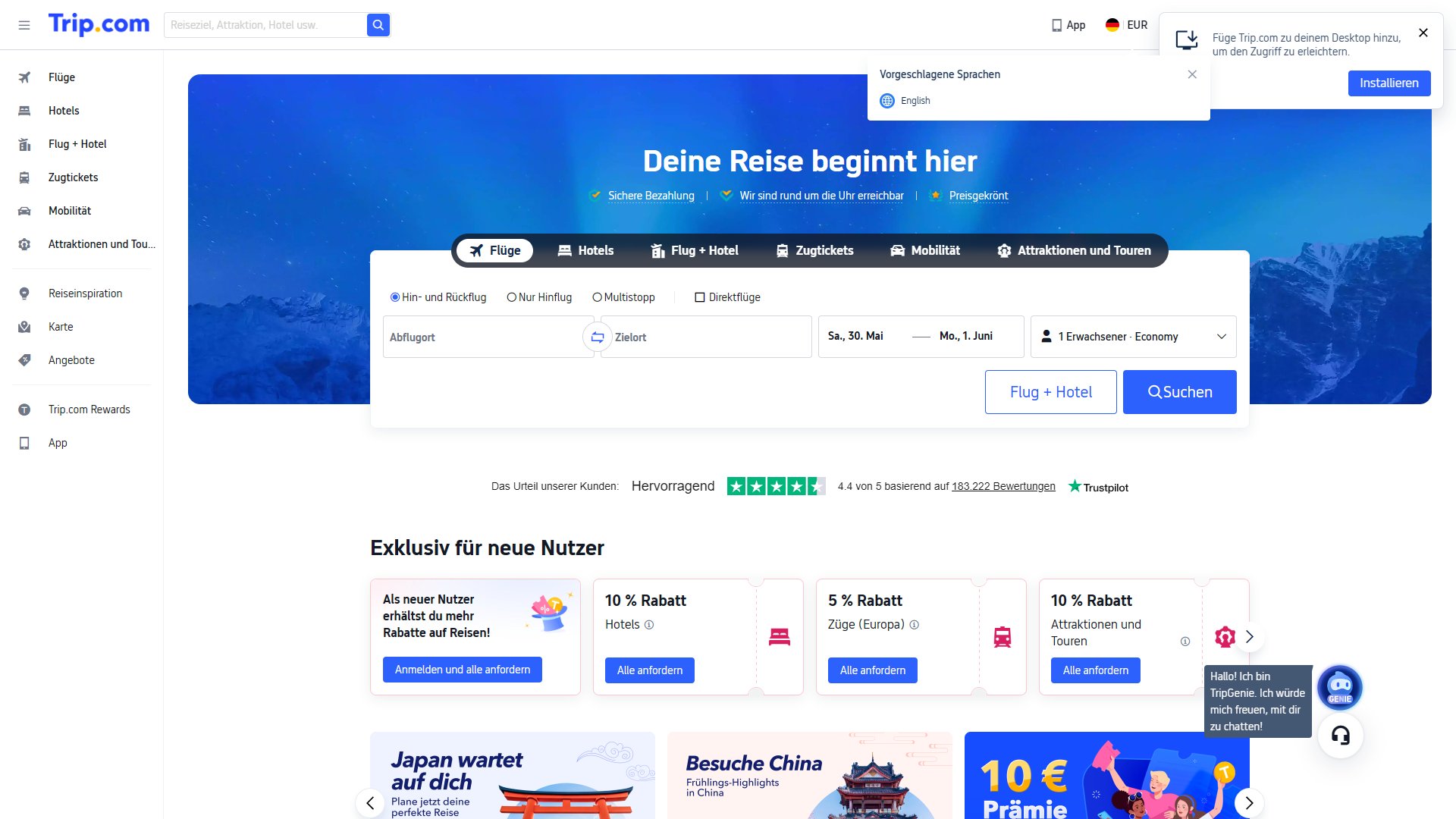
Trip.com is one of the most complete OTAs in this group. Its core strength is not just hotel booking, but the ability to combine hotels with flights, trains, transfers, attractions, and other travel products in a single app. That makes it especially relevant for Asia-linked itineraries where travelers often move between countries or need more than one service to complete a trip.
The brand’s ecosystem is a major advantage. Trip.com Group also operates Ctrip, Skyscanner, and Qunar, which gives it reach across direct booking and traffic acquisition channels. In practical terms, this often translates into strong inventory breadth and competitive pricing on routes and destinations tied to Asia-Pacific travel flows. Its app-first design, multilingual support, and multi-currency functionality make it convenient for international users.
The main weakness is typical of large OTAs: post-booking complexity. If a hotel changes policy or a supplier creates friction, the platform is only partly in control. Public reviews often show that service quality can vary depending on the issue, the market, and the partner involved. Still, as a general booking environment, Trip.com is one of the strongest all-round options for Asia.
Agoda: strong for hotel pricing and inventory depth in Asia
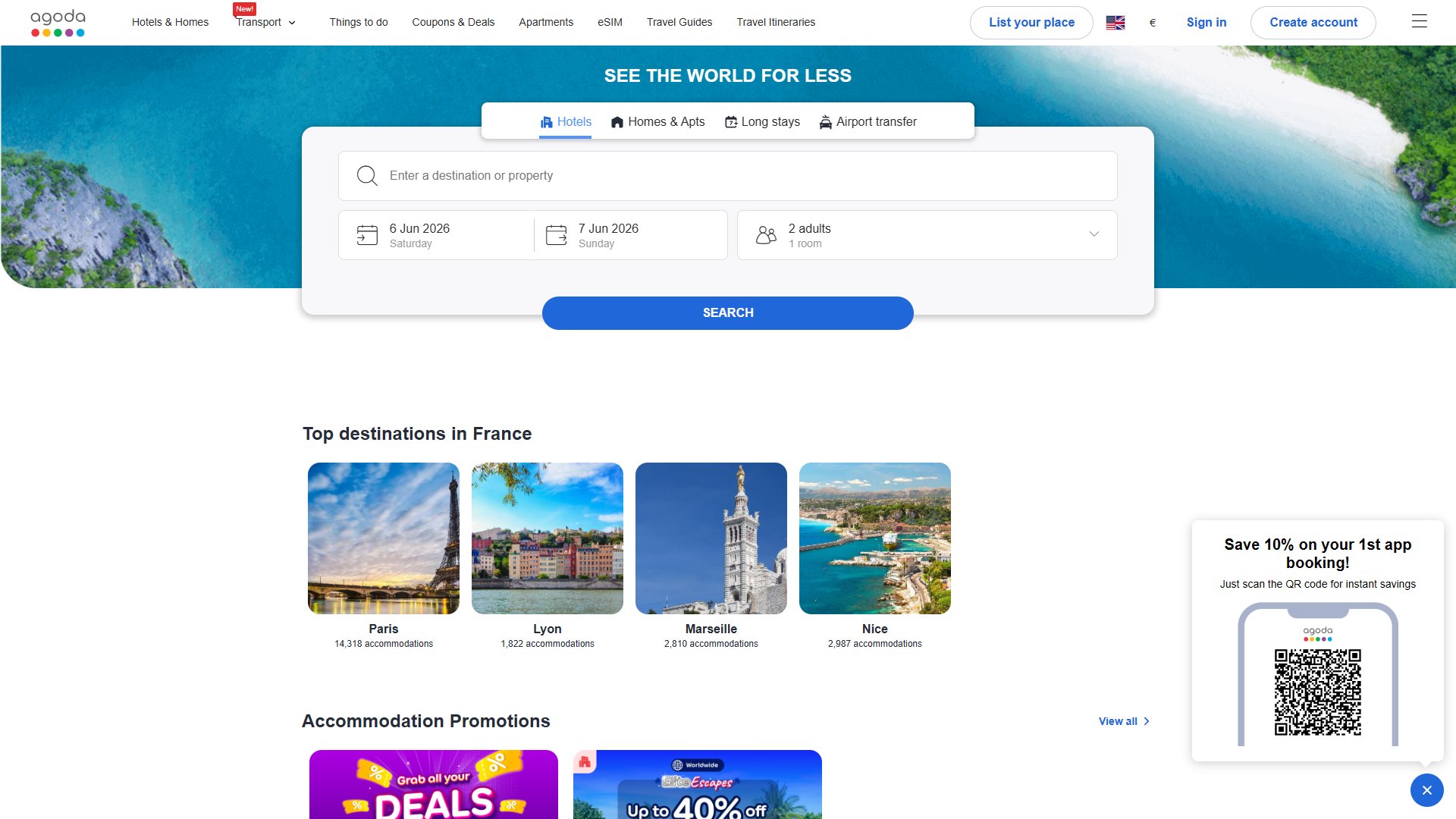
Agoda is the most hotel-centric platform in this comparison, and that focus works to its advantage. It is especially strong in Asia-Pacific, where its hotel inventory is deep and its pricing is often competitive. For travelers whose main goal is to compare hotel rates across major Asian destinations, Agoda is one of the first platforms worth checking.
Its mobile-first approach is a major part of the proposition. Agoda’s app experience, filtering, and promotional structure are built around speed and conversion. Discount-led pricing, mobile-only offers, and frequent promotions make it highly competitive in hotel searches. The backing of Booking Holdings also gives the platform scale and supply strength.
The trade-off is service perception. Agoda’s public review profile often reflects a common OTA tension: good prices and broad inventory, but inconsistent support in cancellation and refund cases. That does not make it a poor platform. It means the traveler should read rate conditions carefully before booking. If the itinerary is firm, Agoda can be a strong option. If flexibility matters, the user should compare service terms closely.
Expedia: strong for global familiarity and bundled travel value
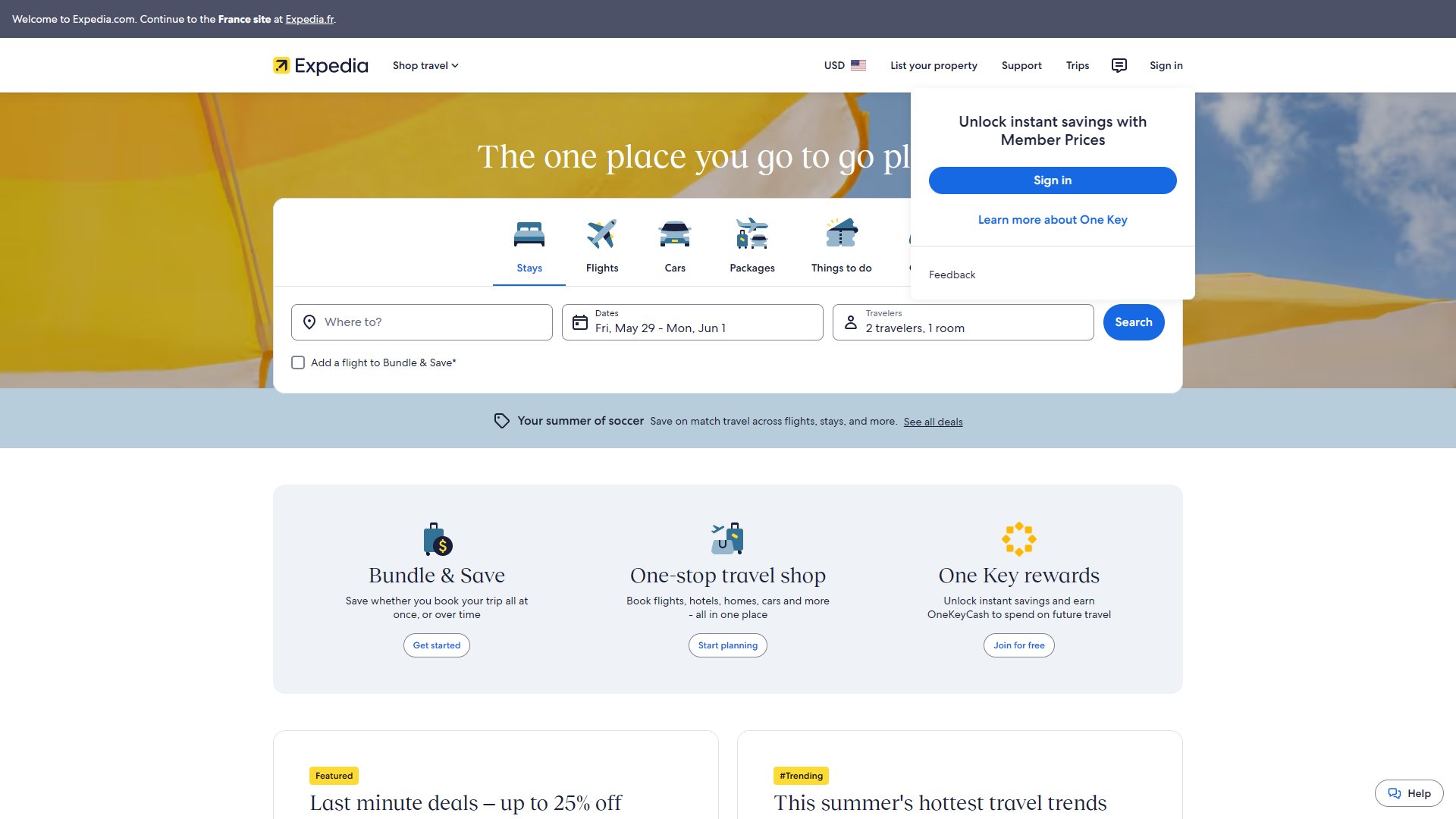
Expedia remains one of the most recognizable travel brands globally, and its strength in Asia is tied less to hyper-local specialization and more to breadth. It is a mature OTA with strong hotel, flight, car rental, and package capabilities. For travelers who want to book a complete trip in one place, Expedia is one of the most established options.
The company’s One Key loyalty structure and package bundling are important commercial tools. Expedia is often attractive when the traveler is booking a flight and hotel together, or when loyalty and member pricing add value. Its platform is polished, broad, and familiar to international users who travel across regions.
At the same time, Expedia is not usually the most aggressive price leader in Asian hotel-only searches. Its value is often in convenience, ecosystem breadth, and brand familiarity rather than the lowest nightly rate. Service quality is generally solid, but like other OTAs, it can become uneven when a booking is disrupted.
Hotels.com: strong for hotel-only simplicity
Hotels.com is narrower than Expedia, but that narrowness is also its identity. It is a hotel-first booking platform with a clear proposition: search, book, and manage accommodation without the complexity of a broader travel super-app. For travelers who do not need flights, trains, or transfers in the same interface, that simplicity can be an advantage.
The brand benefits from Expedia Group infrastructure, which supports inventory access and platform maturity. Its hotel-focused positioning makes it intuitive for repeat accommodation booking, especially for users who value a straightforward interface and member pricing mechanics. In a crowded market, clarity itself becomes a commercial asset.
The limitation is obvious: it is less versatile than Trip.com or Expedia, and less Asia-specialized than Agoda or Traveloka. If the goal is to compare hotel stays in Asia only, Hotels.com is useful. If the goal is to manage a broader itinerary, it is less compelling than the more integrated platforms.

Traveloka: strong for Southeast Asia and local payment convenience
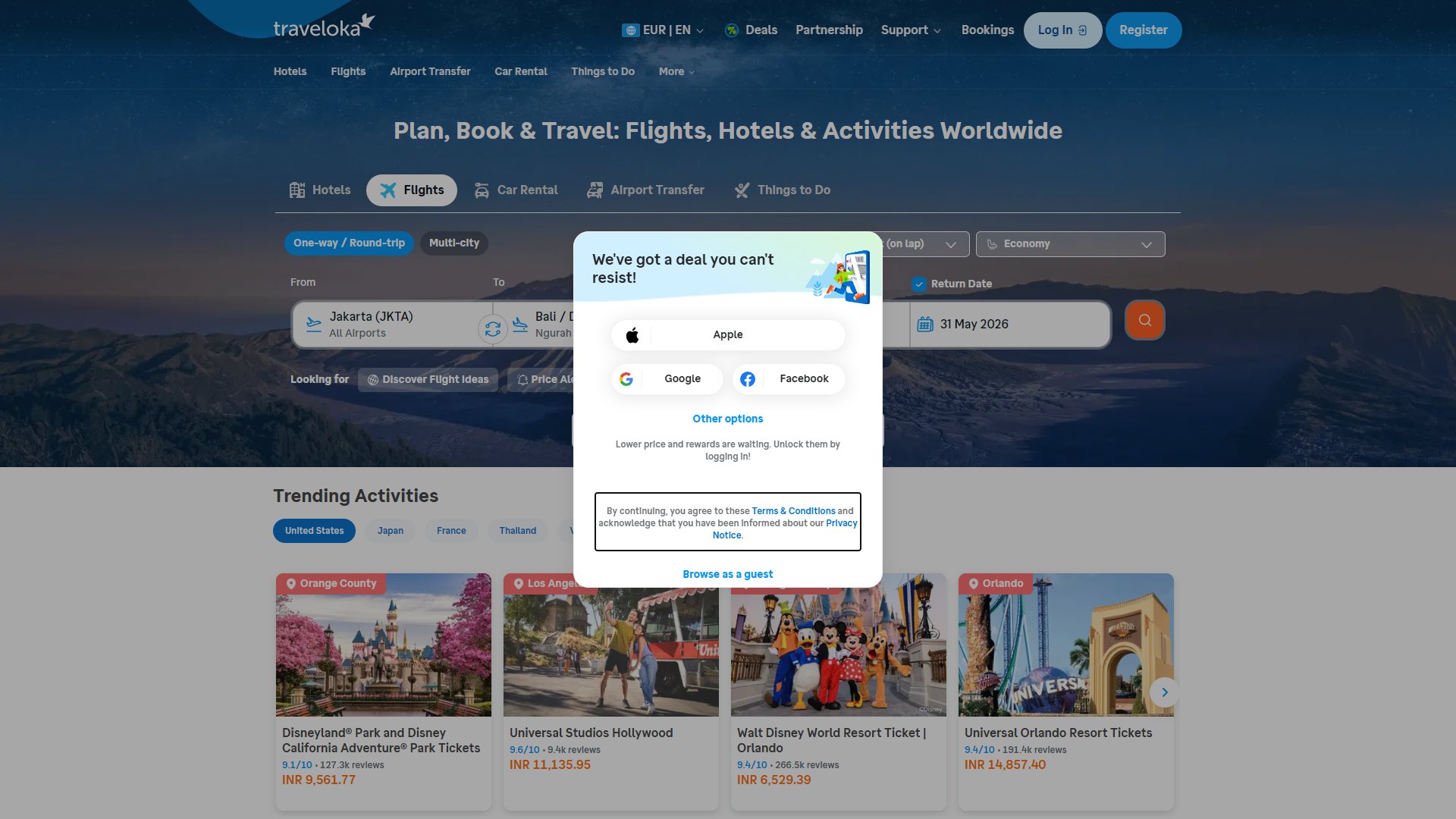
Traveloka is the most regionally focused brand in this comparison. Its core strength is Southeast Asia, especially Indonesia, where it has strong brand recognition and a product structure adapted to local travel behavior. It is not just a hotel site; it is a broader travel and lifestyle booking platform with flights, hotels, transfers, attractions, insurance, and selected local services.
Traveloka’s value lies in localization. The platform is built around mobile-first booking, regional payment methods, and a user experience that feels more tailored to Southeast Asian markets than many global OTAs. For travelers inside the region, that can be a meaningful advantage. It often means smoother payment flows, more relevant offers, and better alignment with local travel patterns.
The downside is geographic concentration. Traveloka is highly relevant in Southeast Asia, but it does not have the same global scale or cross-border breadth as Trip.com or Expedia. For users traveling beyond its core markets, its advantage narrows. Still, within Southeast Asia, it remains one of the most practical and commercially strong choices.
What this means in practice
The market is not asking one platform to do everything equally well. Trip.com is a strong fit for cross-border itineraries and multi-product travel. Agoda is often the strongest hotel price and inventory specialist in Asia. Expedia is the most established broad OTA with package value. Hotels.com is the cleanest hotel-only option. Traveloka is the most localized Southeast Asian platform with strong payment and app convenience.
Comparison table: the five best-known options for Asia
The table below compares the platforms by the criteria that matter most in real booking decisions: cost, approach, geography, audience fit, specialization, and limitations.
| Platform | Typical cost position | Approach | Country / region strength | Best fit | Specialization | Key limitations |
|---|---|---|---|---|---|---|
| Trip.com | Competitive, especially on Asia-linked routes | Multi-product OTA with app-first experience | Asia-Pacific, international cross-border travel | Travelers booking hotels plus transport or flights | Broad travel ecosystem | Post-booking service can vary by supplier |
| Agoda | Often very competitive on hotel rates | Discount-led hotel platform with mobile focus | Asia-Pacific, especially Southeast Asia | Hotel-only searches where price matters most | Accommodation | Support and refund handling can be uneven |
| Expedia | Competitive, especially in bundles | Broad global OTA with loyalty and packages | Global, strong brand recognition | Travelers booking complete itineraries | Generalist OTA | Not always the cheapest hotel-only option |
| Hotels.com | Market-based, often comparable to peers | Hotel-first booking platform | Global, via Expedia Group | Users who want a simple hotel booking flow | Accommodation | Less versatile than broader OTAs |
| Traveloka | Competitive within Southeast Asia | Localized travel and lifestyle platform | Southeast Asia, especially Indonesia | Regional travelers needing local payment support | Travel + lifestyle ecosystem | Less global scale outside core markets |
How prices differ across the platforms
Price is the most visible factor, but also the easiest one to misread. The same hotel can appear cheaper on one platform and more expensive on another because the rate structure may include different taxes, fees, cancellation conditions, or loyalty discounts. That is why price comparison in Asia should always be done on the final checkout page, not only on the search results page.
Agoda is often highly competitive on hotel pricing in Asia, especially where mobile deals and promotional inventory are strong. Trip.com is competitive on Asia-linked travel and can be attractive when flights and hotels are booked together. Expedia tends to be more compelling when bundle value or loyalty benefits offset the room rate. Hotels.com usually competes on hotel convenience and member pricing rather than pure discount leadership. Traveloka is strongest where local market promotions and payment convenience create extra value.
There is also a service-cost trade-off. A platform that is slightly more expensive may still be better if it offers clearer cancellation terms, better support, or easier rebooking. In hotel booking, the cheapest option is not always the lowest-risk option.
What this means in practice
The most rational approach is to compare at least two types of platforms: one global OTA and one regional specialist. For example, Trip.com versus Agoda for Asia hotel bookings, or Expedia versus Traveloka for a broader itinerary. That comparison usually reveals whether the advantage is price, flexibility, or ecosystem convenience.
Common mistakes travelers make when booking hotels in Asia
The first mistake is booking by brand reputation alone. A platform may be well known globally but weaker in a specific Asian market. The second mistake is ignoring cancellation rules. In Asia, as elsewhere, the cheapest rate is often non-refundable, prepaid, or tied to stricter conditions. That is acceptable only when the trip is certain.
The third mistake is assuming customer support works the same way across all platforms. It does not. Some OTAs are better at multilingual support, some at app-based self-service, and some at handling regional payment issues. The fourth mistake is not checking whether the property itself is reliable. OTA quality and hotel quality are not the same thing.
Finally, many travelers overlook the role of local payments. In Southeast Asia especially, the ability to pay through familiar methods can be more valuable than a small rate difference. That is one reason Traveloka and Agoda remain competitive in their core markets.
What this means in practice
A good booking decision is not just about saving a few dollars. It is about reducing the probability of a bad outcome: a refund dispute, a failed payment, a mismatch between room description and reality, or a support case that takes too long to resolve.
Pricing and value: what each platform really sells
Trip.com sells breadth plus convenience. Agoda sells price strength and hotel inventory depth. Expedia sells ecosystem value and package logic. Hotels.com sells simplicity and hotel focus. Traveloka sells localization and regional convenience. These are not just marketing lines; they are the commercial structures each company uses to convert bookings.
That is why the “best” site depends on the trip type. A business traveler going from Singapore to Hong Kong may prefer Expedia or Trip.com. A leisure traveler booking a resort in Bali may find Agoda more compelling. A Southeast Asian traveler who wants local payment flexibility may prefer Traveloka. A user booking only a hotel stay and wanting a straightforward interface may choose Hotels.com.
In other words, the market rewards fit. The platform that is best for one itinerary can be mediocre for another.
Risk factors and operational realities
The main risk across all five platforms is intermediary dependence. None of them fully controls the hotel itself. If a property overbooks, changes policies, or disputes a reservation, the OTA can only mediate. That is why refund, cancellation, and modification experiences vary so much.
Another risk is rate opacity. Some platforms show attractive headline prices but add taxes, fees, or rate conditions later in the flow. This is not unique to Asia, but it matters more in cross-border booking because currency conversion and local tax rules can complicate the final cost.
There is also a strategic risk for travelers: over-optimizing for price can reduce flexibility. If the itinerary is uncertain, a slightly higher refundable rate may be more valuable than a lower non-refundable one. That is especially true for multi-city trips in Asia, where weather, transport schedules, and visa timing can affect plans.
What this means in practice
The safest booking strategy is to use the platform as a pricing and inventory tool, not as a substitute for reading the rate terms. The best sites make this easier, but they do not eliminate the need to review the conditions carefully.
FAQ
Which is the best site for booking hotels in Asia overall?
There is no single winner for every case, but Trip.com and Agoda are among the strongest all-round options for many Asia-focused hotel searches. Trip.com is better for cross-border and multi-product travel, while Agoda is often stronger on hotel pricing and inventory depth.
Which platform is best for Southeast Asia?
Traveloka is especially strong in Southeast Asia because of its localization, payment methods, and regional product design. Agoda is also very strong in the region, particularly for hotel inventory and pricing.
Which site is best if I want a flight and hotel together?
Expedia and Trip.com are natural choices for bundled travel. Expedia is strong in package value, while Trip.com is often better for Asia-linked itineraries and app-based convenience.
Which platform is safest for flexible bookings?
No OTA is risk-free, but platforms with clearer rate terms and stronger service tools tend to be safer. In practice, the safest booking is the one with refundable terms and transparent conditions, regardless of platform.
Is Hotels.com still relevant if it only focuses on hotels?
Yes. For travelers who want a simple hotel-first booking experience, Hotels.com remains relevant. Its narrower scope is a limitation for some users, but a strength for others who do not need a broader travel bundle.
Conclusion
The best hotel booking sites in Asia are not interchangeable. Each of the five platforms in this comparison occupies a distinct commercial position. Trip.com is a strong multi-product cross-border OTA. Agoda is a hotel specialist with strong pricing and inventory depth in Asia. Expedia is a broad global generalist with package logic. Hotels.com is a clean hotel-only platform. Traveloka is a localized Southeast Asian travel ecosystem.
For travelers, the practical takeaway is simple: do not choose by brand familiarity alone. Choose by trip type. If the journey is cross-border and includes several services, Trip.com is often efficient. If the priority is hotel price in Asia, Agoda deserves close attention. If the booking is a package, Expedia becomes more attractive. If the goal is a simple hotel reservation, Hotels.com can be enough. If the trip is centered in Southeast Asia and local payments matter, Traveloka is often the most practical.
In a market this fragmented, the smartest traveler is not the one who always uses the same site. It is the one who understands what each platform is optimized to do.